For illustrative purposes only
A pregnant woman collapsed in first class in front of a silent cabin. Then I opened my beat-up notebook—and her billionaire husband realized I was about to ask for something money couldn’t buy.
The alarm screamed at 4:30 a.m., the kind of shrill plastic rage that made you feel guilty for being alive. I rolled out of bed in the cramped apartment above Rodriguez Laundromat on the South Side of Chicago, my socked feet finding the cold linoleum. The radiator knocked like it wanted to fistfight the wall. Paint peeled in long curled strips by the window, and the scent of my grandma’s coffee slid under my bedroom door like a promise.
“Morning, Grandma May,” I called, dragging a hand through my hair.
“In here, baby,” she said, already moving around the tiny kitchen like she owned the whole world.
May Walker was seventy-three, five feet nothing, and tougher than the winter wind off Lake Michigan. Diabetes had been trying to slow her down for years. It hadn’t won yet. She set a plate of scrambled eggs in front of me and watched while I sat down at the wobbly table.
“You eat every bite,” she said. “Long day ahead.”
I nodded and tried to smile like everything was fine. The truth was sitting on the counter, leaning against the jar of instant coffee: an unopened acceptance letter from the community college EMT program. My dream school, if you could call it that. My dream uniform. My dream chance to be the guy who showed up when someone’s worst moment showed up first.
I didn’t touch the envelope.
Grandma May followed my eyes. “You gonna open that letter sometime?”
“What’s the point?” I said, keeping my voice light. “We both know I can’t afford it.”
Her gaze sharpened, soft and sharp at the same time. “Don’t talk like you know the future.”
I swallowed. In my wallet were forty-seven dollars in crumpled bills—what was left after I’d helped her cover her medication last week. Forty-seven didn’t buy tuition. It barely bought groceries. It definitely didn’t buy “someday.”
I forced myself to eat, then kissed her forehead. “I’ll be back tonight. Try not to watch the news.”
She snorted. “Try not to let them work you to death at that airport.”
O’Hare was a city inside a city, loud and bright and never asleep. By six, I was clocking in for my baggage handler shift, the time card machine blinking green like it approved of me. My supervisor, Mr. Carter, waved me over.
“Walker. We’re short on cabin cleaning today. You mind switching?”
“Whatever you need,” I said. I always said that. Eight months working there and I’d never missed a shift. Never complained. Never asked for anything. People like me didn’t get to be “difficult.” People like me stayed grateful.
During lunch, I sat in the break room with my cracked phone and my beat-up composition notebook. The screen was spiderwebbed so bad you had to tilt it just right to see anything. I opened YouTube anyway: shock symptoms, CPR, airway management. I wrote notes in cramped handwriting like the words could turn into a certification if I believed hard enough.
My coworker Rico slid into the seat across from me, tearing open a bag of chips. “Man, you still studying on that busted phone?”
“Knowledge is knowledge,” I said without looking up. “Doesn’t matter where it comes from.”
“You’re seventeen,” he laughed. “You should be worried about girls and parties.”
I thought about Mrs. Rodriguez cracking her head on the stairs and me keeping her still until paramedics came. I thought about little Miguel turning blue from a bee sting, and how I’d called 911 anyway. That’s why I studied.
“Somebody’s gotta worry about something,” I said.
After my shift, I walked home past the corner store with bulletproof glass and the empty lot where kids played basketball on a rim that leaned like it was tired. A faded mural of Dr. King watched over us with chipped paint and stubborn eyes. Mrs. Rodriguez was outside her building struggling with groceries, arthritis making her hands shake.
“Let me get those,” I told her, taking the bags.
“Oh, Ethan,” she said, smiling like I was her own. “You’re such a good boy. Here, take five dollars.”
“Keep it,” I said. “Neighbors help neighbors.”
That night, Grandma May had the news on anyway. Another shooting. Another politician pretending to care. Another story about kids with no opportunities. She muted it when I walked in.
“Sometimes I wish we could move somewhere safer,” she said.
“This is home,” I told her, and I meant it. “These are our people.”
Later, lying in bed, I listened to sirens in the distance. Ambulances rushing toward somebody’s disaster. I imagined myself in that uniform, the calm voice, the hands that knew what to do. I didn’t know why I studied so hard. I wasn’t going to med school. I wasn’t even sure I’d get into the EMT program. But something inside me kept whispering, Keep learning. Keep preparing. You never know when someone might need you.
The next morning at O’Hare, the airport buzzed with weekend travelers and rolling suitcases and the smell of overpriced coffee. Mr. Carter intercepted me at the time clock again.
“Walker, I need you on cabin cleaning. We’re short three people.”
“No problem.”
“Flight 447 to London. International departure gate B17. First class needs extra attention.”
London. The word sounded like a movie. Like fog and accents and places I’d never see. I grabbed my cleaning cart and headed to the gate.
The Boeing 777 sat massive on the tarmac, a white whale with wings. I boarded through the crew entrance and wheeled my cart down the narrow aisle. First class hit me like another planet—leather seats, glossy wood, real glassware. It smelled like money and perfume. I kept my eyes down and worked.
Wipe tray tables. Vacuum carpets. Restock amenities. Don’t be seen.
That’s when I noticed the luggage being loaded: Louis Vuitton suitcases, Hermès bags, a leather briefcase with gold initials—R.S. I muttered, “Fancy,” and kept going.
Passengers began boarding while I finished the forward cabin. The vacuum broke. I had to swap it out. Time slid away, and before I knew it, the captain’s voice came over the speaker.
“Ladies and gentlemen, we’re experiencing a slight delay. We’ll be underway shortly.”
The delay stretched. Twenty minutes. Thirty. I was still hunched near the rear galley, wiping fingerprints off a stainless-steel panel, when the engines started to roar.
My head snapped up. My stomach dropped.
I was still on board.
I spotted a flight attendant—blonde hair, sharp eyes, name tag that read JESSICA—and I hurried over. “Ma’am, I’m maintenance crew. I need to get off before takeoff.”
She checked her watch, then glanced toward the cockpit with the kind of look that meant she already knew the answer. “I’m sorry. We’re cleared for departure. Captain can’t stop the sequence now.”
My mouth went dry. “What do I do?”
“Find a crew seat in the back,” she said. “We’ll sort it out when we land in London.”
London.
The plane lifted off. Chicago disappeared beneath a blanket of cloud. I pressed my forehead to the cool plastic wall and tried to breathe.
Thirty minutes into the flight, the cabin lights dimmed for overnight service. Passengers settled under blankets like they were settling into their own private worlds.
Then the screaming started.
Help! Somebody help us!”
The sound sliced through the calm like a siren. I unbuckled and moved forward, my feet remembering the plane’s layout from a hundred cleanings. I reached first class and found chaos.
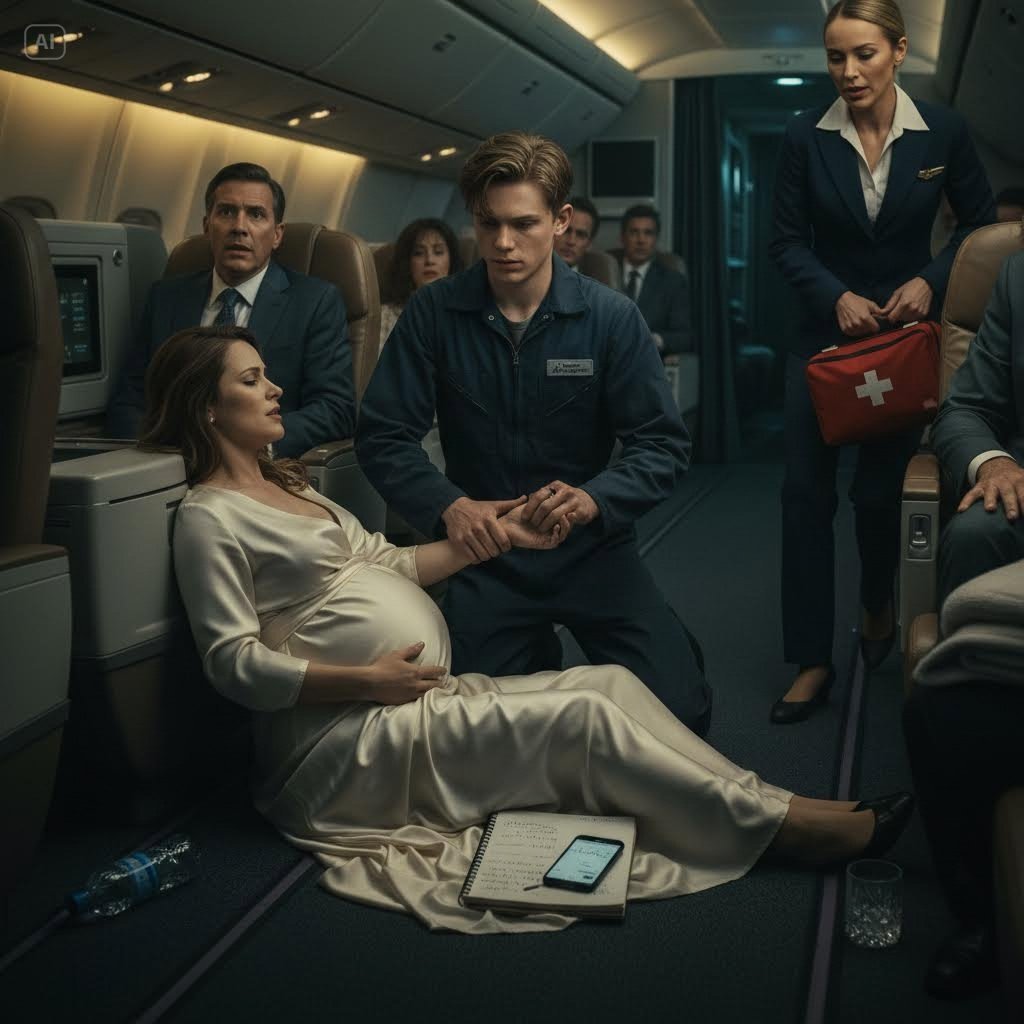
A woman in an elegant cream dress lay collapsed in the aisle, her face ghost white. Her hands clutched her pregnant belly. She looked about thirty-five, perfect hair now messy against the carpet, jewelry catching the emergency lighting like sparks.
Beside her, a man in a tailored suit knelt, panic wrecking whatever calm he wore like armor. “Sarah! Sarah, stay with me!”
Flight attendants hovered, radios in their hands, fear in their eyes. Jessica spoke into hers. “We need a doctor in first class. Medical emergency. Any doctors on board, please identify yourselves immediately.”
Silence.
Jessica’s voice tightened. “No medical professionals. I repeat, no medical professionals on board.”
The husband looked around, desperation turning his face raw. “We have to land. Turn around. Do something!”
“Sir,” Jessica said, “we’re over the Atlantic. Nearest airport is hours away, and weather—”
Sarah’s breathing hitched, rapid and shallow. Her lips were pale. Her eyes rolled back for a second, then fluttered.
I recognized the signs from my cracked-phone lessons: shock, maybe premature labor. My heart slammed against my ribs. I wasn’t a doctor. I wasn’t certified. I was a kid who cleaned planes and watched videos during lunch.
But I was the only person on this plane who had even tried to learn.
I stood at the edge of the first-class cabin, hands sweating, stomach twisting. Every wealthy face stared at Sarah like money could fix it if they stared hard enough. The husband’s eyes snapped to mine, wild and pleading.
In that moment, I heard my own inner voice, the one that had whispered keep preparing. It didn’t whisper now. It shouted.
I stepped forward. “I can help.”
Jessica turned toward me like I was oxygen. “Are you a doctor?”
“I have medical training,” I said, and it was the truth I could live with. My training was messy and unofficial and bought with broken pixels, but it existed.
Sarah’s husband grabbed my sleeve. “Please. Do something. Anything.”
I knelt beside Sarah. The carpet smelled faintly of champagne and expensive cologne. My hands shook, but my voice came out steady.
“Ma’am, can you hear me?” I asked.
Her eyelids fluttered. She was semi-conscious.
“I need blankets,” I told Jessica. “Bottled water. First aid kit. Now.”
Jessica didn’t argue. She moved.
I turned to the husband. “What’s her name?”
“Sarah,” he choked out. “Sarah Sterling.”
“How far along?”
“Seven months.”
Seven months. The baby could survive if it came early, but Sarah could hemorrhage. She could seize. She could die. The word die tried to push into my mind, and I shoved it away.
“Okay,” I said, because okay was a bridge between panic and action. “Sarah, my name’s Ethan. I’m going to help you. I need you to stay with me.”
I checked her pulse at her wrist: fast but present. I guided her onto her left side and elevated her legs with pillows and folded blankets. Left lateral position, reduce pressure on major blood vessels. I’d watched a video about it three times because it scared me.
“What are you doing?” the husband demanded, voice cracking.
“Improving blood flow to the baby,” I said. “Reducing pressure.”
Jessica returned with supplies, breathless. I wrapped a damp cloth around Sarah’s forehead. “Sarah, breathe with me. In through your nose, out through your mouth.”
Her eyes found mine. For a second, in that cramped aisle, it felt like the whole plane held its breath with her.
“Any cramps?” I asked.
She nodded weakly.
“Scale of one to ten?”
“Six,” she whispered.
“Any bleeding?”
“A little.”
My stomach clenched. “We need to keep you calm and still,” I said. “No sudden movements.”
Jessica hovered. “Captain wants an update.”
“Tell him she’s stable for now,” I said, monitoring Sarah’s pulse again. “Tell him we need the smoothest ride possible.”
The husband—Robert, I realized, because the initials on the luggage—ran a hand through his hair. “How do you know all this?”
“I study,” I said.
For the next two hours, I didn’t leave Sarah’s side. I counted her breaths. I timed the contractions. I kept her talking during pain, asking about the baby’s name, the nursery, anything to anchor her to a story beyond this aisle.
“Girl,” she said at one point, tears shining. “Emma.”
Robert watched me like he was seeing a language he’d never learned. The other first-class passengers stayed quiet, their power useless against biology and altitude.
When Sarah’s pain spiked, I guided her through slow breathing, counting, grounding. “Look at me,” I told her. “Stay with me. You’re not alone.”
Her skin warmed under my fingers. Her breathing steadied. The contractions eased, spacing out from five minutes to seven, to ten.
Jessica returned with a whisper from the cockpit. “Ninety minutes to Heathrow.”
“We can make that,” I said, though my throat was tight. “We can.”
When the plane began to descend, Sarah was awake, exhausted, but stable. The emergency lights faded back to normal cabin glow like the plane was pretending nothing had happened.
As soon as we landed, paramedics boarded, efficient and calm. They assessed Sarah, checked her belly, strapped monitors to her. One of them looked at me and nodded.
“Textbook stabilization,” he said. “You probably saved her and the baby.”
My knees almost gave out. I hadn’t let myself feel relief until that second. Sarah reached out from the stretcher and grabbed my hand.
“I don’t even know how to thank you,” she whispered.
“Just take care of Emma,” I said.
Robert stepped forward, his eyes locked on mine. “Let me give you my information,” he said, business instincts snapping back into place. “I want to properly thank you when we get back to the States.”
He pressed a business card into my palm and a small metal keychain with a logo stamped into it.
“Sterling Enterprises,” it read.
The name meant nothing to me then. I was too busy thinking about Grandma May and the fact that I was stranded in London without a passport.
Three hours later, in a London hospital room that smelled like antiseptic and quiet money, Sarah lay in a pristine bed, monitors beeping steadily. An ultrasound machine filled the room with the rapid, comforting thrum of a heartbeat.
“Both mother and baby are stable,” a doctor said. “Whoever provided care on that aircraft prevented what could have been a tragic premature delivery.”
Robert’s shoulders sagged like someone had finally let him put down a weight.
I stood. “I’m glad she’s okay,” I said. “I should figure out how to get home.”
“Wait.” Robert reached into his suit jacket and pulled out a thick envelope. He slid it toward me on the table. Through the paper, I could see the green edges of cash.
“This doesn’t even begin to cover what you did.”
I pushed it back without opening it. “I can’t take that.”
“It’s twenty-five hundred,” Robert insisted. “And that’s just the beginning.”
“I don’t want your money,” I said, surprised at how easy the words felt. “I’m just glad Sarah and the baby are safe.”
Sarah’s eyes filled. “No one else moved,” she said softly. “You did.”
“Because it was the right thing,” I said. “That’s it.”
“At least take my contact information,” he said, careful now. “I run a business in Chicago. When you’re ready to think about your future… I’d like to help.”
I glanced at the card again. Robert Sterling. Sterling Enterprises.
“Thank you,” I said, slipping it into my wallet mostly because arguing felt rude.
Sarah reached for my hand. “You have a gift,” she said. “You should be a paramedic. Or a doctor.”
“That’s the plan,” I admitted. “Someday.”
I wrote Grandma May’s phone number on a napkin and handed it to Sarah. “If you need anything, call my grandma. She’ll make sure I get the message.”
Sarah blinked. “You’re giving us your grandmother’s number?”
“She’s a good person,” I said. “She’d want to know you’re okay.”
I left the hospital with my stomach still twisting from adrenaline and jet lag and fear. Getting back to Chicago took paperwork, apologies, and a humiliating conversation with customs. When I finally walked through my neighborhood again, the brick buildings looked the same, but I felt like I’d been stretched and snapped back into place.
The London trip started to feel like a dream I wasn’t sure I’d deserved.
Then the black town car showed up outside our building.
It sat there two days in a row, tinted windows, engine purring. The second time, it pulled away the moment I got close enough to see who was inside.
“Grandma,” I asked that night, “you expecting company?”
She looked up from her knitting. “Funny you ask. I got a phone call yesterday. Very polite woman. Asked about you.”
“About me?” My chest tightened.
“Your work schedule,” she said. “Your character. Whether you were reliable.”
I pulled out my wallet and found Robert’s business card like it had been waiting. The keychain sat in my pocket, cool metal against my fingers.
At work the next day, Mr. Carter pulled me aside. “Somebody’s been asking questions about you, Walker.”
“What kind of questions?”
“Employment history. Whether you’ve ever missed a shift. I told them you’re one of the best we’ve got.”
My throat went dry. “Did I do something wrong?”
“Wrong?” Carter snorted. “Kid, whatever you did, they’re very interested in you.”
That evening, walking home, I noticed something I’d never noticed before: the logo on a construction crane towering over a new development. The same logo stamped on the keychain in my pocket.
Sterling Enterprises.
I saw it again on a sign for a new hospital wing on the South Side. Again on an affordable housing project. Again on a medical center going up in Bronzeville.
Grandma May received another call. “They want to set up a meeting,” she told me, eyes shining like hope was a thing you could hold. “Downtown office. They said it’s about your future.”
My future. The words tasted strange.
The address led to a gleaming skyscraper in the financial district. Sterling Enterprises carved in marble above the entrance. The lobby was all glass and stone and security guards who looked like they’d never ridden the Red Line.
The receptionist smiled when I approached. “Ethan Walker?”
“Yes, ma’am.”
“Mr. Sterling is expecting you. Fortieth floor.”
The elevator ride made my stomach float. My reflection stared back from the polished steel: duct-taped sneakers, thrift-store shirt, hands that didn’t belong in this building.
The fortieth floor was executive territory, quiet as a church. A secretary led me past walls lined with awards and plaques. Chicago Business Leader of the Year. Humanitarian of the Decade. Robert Sterling.
She opened double doors to a conference room with windows that swallowed the city. The whole skyline stretched out, and my neighborhood looked small and far away.
Robert Sterling stood by the window, not the panicked husband on the plane but something colder and sharper: a man who made decisions that shaped streets.
“Mr. Walker,” he said, turning. “Please, sit.”
I sat at the long table, palms sweating.
“Do you know what Sterling Enterprises does?” he asked.
“Construction,” I said, because I’d seen the cranes.
He gestured to the window. “See those cranes? The new hospital on the South Side. The housing on Michigan Avenue. The medical center in Bronzeville. We built half of modern Chicago.”
The weight of it pressed on my chest.
“I’ve spent the last week learning everything I can about you,” Robert continued, opening a folder. Inside were pages from my life: school records, attendance, job history.
“Perfect attendance at O’Hare,” he read. “Teachers say you’re gifted but humble. Your neighbors—” He flipped a page, eyes scanning. “The kid who helps elderly women with groceries and won’t take a dime.”
Heat crawled up my neck. “I just try to help.”
“And that,” Robert said, leaning forward, “is exactly why I looked for you.”
I blinked. “Looked for me?”
“Character first,” he said. “Skills second. I can teach skills. I cannot teach integrity.”
He slid another folder toward me. On the cover was a title: Sterling Community Health Initiative. Inside were architectural renderings of training centers—classrooms, simulation labs, ambulances for hands-on practice.
“We’re launching a division focused on health infrastructure in underserved communities,” he said. “Free EMT certification programs. Job placement guarantees. Three centers to start.”
He pointed to a map of Chicago. Red circles marked neighborhoods I knew by heart.
South Side. West Side. East Garfield Park.
My throat tightened.
“Each facility could certify a hundred EMTs annually,” Robert said. “Three hundred total. Completely free.”
I stared at the map like it was a miracle drawn in ink.
“I need someone to run this division,” he said. “Someone who understands these communities from the inside. Someone with leadership under pressure.”
He slid another packet toward me—compensation, benefits, tuition coverage. “Seventy-five thousand starting salary while you complete your own education. Full tuition for your EMT program, then a four-year degree in healthcare administration. Management training throughout.”
Then he set a check on the table, face up.
Twenty-five thousand dollars.
My hands shook as I stared at it. Twenty-five thousand meant Grandma May’s medicine. It meant rent. It meant breathing room. It meant the eviction notice she thought I hadn’t seen.
“Consider it immediate relief,” Robert said. “You’d start immediately.”
Every part of me wanted to grab the check like it was a life raft.
But another part of me—the part that had carried groceries for Mrs. Rodriguez and sat with Miguel until the ambulance came—felt something else.
A question.
I looked back at the map with its three red circles. “Where would these centers be built?” I asked.
Robert nodded, as if he’d expected the question. “Right there,” he said, tapping the neighborhoods. “Where they’re needed.”
“How many people would the centers train?” I asked, even though he’d told me.
“A hundred each per year,” he repeated. “Guaranteed jobs through our partnerships with hospitals, plus on-site medical staff for our construction sites.”
I swallowed. “This is incredible,” I said. “Life-changing.”
Robert’s eyes held mine, waiting for gratitude, for surrender.
I took a breath. “But I can’t accept it.”
Silence filled the room so completely I could hear the building’s air system hum.
Robert blinked once. “You—what?”
“I can’t accept it,” I repeated, voice steadier than my hands. “Not like this.”
His jaw tightened, confusion flashing. “I don’t understand.”
I stood and walked to the window, staring down at the city. Somewhere down there, kids were waking up in cramped apartments, counting bills, deciding which dream to starve first.
“You’re offering to change my life,” I said, turning back. “But what about everyone else? What about the kids like me who won’t get lucky enough to be on the right plane at the right time?”
Robert’s eyes narrowed.
“I don’t want this just for me,” I said. “I want to build something bigger.”
“Bigger,” he echoed.
“These three centers are a start,” I said, tapping the map. “But there are dozens of underserved communities in Chicago. Hundreds across the country.”
Robert leaned back, studying me the way he’d studied those files. “You’re talking about hundreds of millions of dollars.”
“I’m talking about changing the landscape,” I said, and my voice surprised me with its heat. “Free EMT training is the beginning. What about paramedic programs? Nursing degrees? Medical school prep? These centers could be health hubs. Free clinics. Mobile units. Partnerships with universities.”
Robert didn’t speak. His silence felt like a dare.
I pushed the check back toward him. “I don’t want your charity,” I said. “I don’t want to be rescued. I want to be equipped to help everyone who’s still stuck.”
Robert stared at the check, then at me. For the first time since I’d met him, the billionaire looked unsure.
“You want to be a partner,” he said slowly.
“Yes,” I said. “Teach me. Back me. Let’s build a model that can go national. Let’s make it so a kid with a cracked phone and a good heart doesn’t have to wait for a miracle.”
I shrugged. “So were you once.”
“Okay,” he said. “Write down what you think phase one looks like.”
My throat tightened again, but this time it wasn’t fear. It was something closer to hope, heavy and real.
Six months later, the first Sterling Community Health Center rose from an empty lot on the South Side. On opening day, I stood in a hard hat and a polo shirt with the Sterling logo, watching the final equipment get installed. The air smelled like fresh paint and new beginnings.
Construction workers called me by name. I knew theirs. I brought coffee when the wind bit. I asked about their kids. Maria Santos, the lead electrician, elbowed me when I stared too long at the simulation lab.
“Looking good, boss,” she said. “My daughter already signed up for the first EMT class.”
“She’s gonna crush it,” I told her, grinning.
The ribbon-cutting drew cameras and politicians. Mayor Johnson gave a speech about partnerships. Reporters asked how an eighteen-year-old ended up running a program like this. I adjusted my tie, still not used to wearing one.
“This isn’t about me,” I said into the microphones. “This is about giving people in my community the same opportunities wealthy neighborhoods take for granted.”
Applicants lined around the block: single moms, former gang members, high school dropouts, veterans, older folks changing careers. People hungry to learn. People who’d been told no their whole lives.
The first class of fifty started that week. I taught some sessions myself, my YouTube notes now backed by real certification and instructors who’d seen everything. We ran trauma scenarios, airway drills, CPR until their arms shook.
“Why does this matter here?” I asked one night.
Hands shot up. Stories spilled: shootings where ambulances came too late. Heart attacks where nobody knew compressions. Overdoses where panic stole seconds.
“That’s why we’re here,” I said. “So our community can take care of its own.”
Sarah Sterling came by often, carrying baby Emma on her hip. Emma’s hair was soft and dark, her eyes curious. Sarah would smile at me like we shared a secret that started at thirty-five thousand feet.
“Her first word was ‘Ethan,’” Sarah joked once.
Robert groaned. “Don’t encourage her.”
I laughed, and the laugh felt like a stitch closing something old.
Two years after the plane, I sat in the driver’s seat of Ambulance 47, now a certified paramedic, checking equipment before my shift. My partner was Maria Santos—the same electrician, now also an EMT instructor on her days off.
“You ever think about how crazy life is?” I asked, testing the defibrillator.
“Every day,” she said, grinning. “Especially working with you.”
The radio crackled. “Unit 47, medical emergency at O’Hare Airport, Gate B17. Elderly male, possible cardiac arrest.”
My hands froze on the steering wheel.
Gate B17.
The same gate where I’d boarded a plane by mistake and stepped into my own future.
“Copy,” Maria said, already pulling on gloves. “Unit 47 en route.”
Sirens howled as we cut through traffic. My heart hammered, not from fear of the job—that part I knew—but from the strange circular pull of the moment.
We reached O’Hare in eight minutes. A crowd had gathered near the gate, a ring of anxious faces. On the floor lay an elderly Black man, lips tinged blue, breathing shallow.
Beside him knelt a teenage boy, tears streaking his cheeks. “Grandpa, please,” he whispered. “Please don’t leave me.”
I dropped to my knees and began assessing. Pulse weak but present. Airway partially obstructed. Oxygen, now. IV, now. Maria moved like lightning. The training center lessons, the real-world calls, the muscle memory—they all snapped into place.
“Sir,” I asked the teenager, keeping my voice calm, “what’s your grandfather’s name?”
“William,” he choked out. “William Thompson.”
“Okay, Marcus,” I said after he answered my next question. “You’re doing good. Stay right here. Talk to him.”
Marcus stared at me. “How do you know my name?”
“Your badge,” I lied gently, because the truth was simpler: I saw myself in his face.
We stabilized William enough to transport. As Maria coordinated with airport staff, I noticed Marcus counting crumpled bills in his wallet with shaking fingers.
“How much you got?” I asked quietly.
“Twenty-three,” he whispered, ashamed. “I was saving for—” He stopped.
I understood without him finishing. Dreams always had a price tag.
I reached into my pocket and pulled out a business card, edges worn from use.
Robert Sterling’s updated contact information.
I placed it in Marcus’s hand. “Call this number,” I said. “Tell them Ethan Walker sent you. Tell them what happened. Tell them what you need.”
Marcus frowned at the logo. “Sterling Enterprises? I don’t understand.”
“You don’t have to,” I said. “Just trust me. Sometimes the person who helps you is the person you’re supposed to meet.”
Marcus’s eyes widened like those words hit something inside him.
We loaded William into the ambulance. His vitals steadied. Color crept back into his cheeks. As we rolled away from Gate B17, I looked back through the rear windows.
Marcus stood under the gate sign, still holding the card like it might burn or turn into a door.
The radio crackled again. Another call. Another crisis.
Maria glanced at me. “You okay?”
I smiled, small and sure. “Yeah,” I said. “I’m exactly where I’m supposed to be.”
And somewhere behind us, at the same gate where my life changed, another kid was about to learn what I’d learned the hard way: kindness doesn’t just save people. It builds roads.